5 Interesting Facts About the Flag of Greece
Greeks have many things to be proud of, from their rich history and philosophy to the stunning islands (over 6000 in total, with around 200 inhabited) and turquoise waters. Their flag reflects all that and more. With its signature combination of blue and white, horizontal stripes, and the iconic cross in the top left corner, it carries the essence of nature’s beauty and the achievements of past generations that continue to inspire.
When it comes to the flag of Greece, you may think you know it well. Maybe because it’s a symbol you’ve grown up with. Perhaps you’ve studied its history, noticed its iconic blue and white on souvenirs or seen it waving proudly at a festival. Nevertheless, behind it lies a rich story and interesting facts waiting to be discovered.
Get to know some of them, so that next time you wave or spot the flag of Greece, you’ll see it in a new light.
The Cross Represents the Greek Orthodoxy
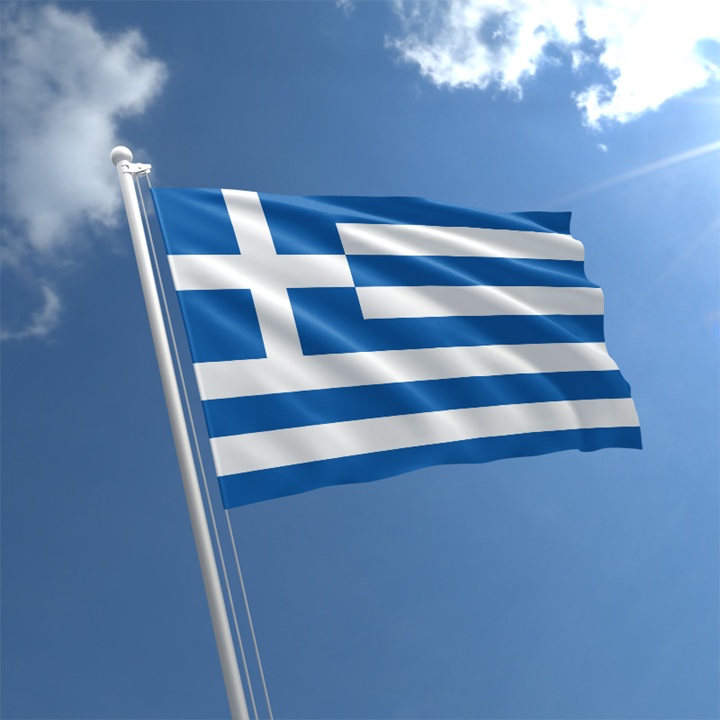
The cross on the Greek flag is more than a decorative element. It carries deep religious and cultural significance. Positioned in the upper left corner of the flag, the white cross stands out against a vivid blue background.
Its simple, symmetrical design symbolises the central role of Greek Orthodoxy in the history and identity of the nation. The cross represents faith, unity, and the spiritual foundation upon which modern Greece was built.
Greek Orthodoxy is the official and predominant religion of Greece. It’s practised by over 90% of the population. It has been central to Greek identity since the Christianization of the Byzantine Empire, and it played a key role in maintaining cultural and religious continuity during Ottoman rule.
Greek Orthodoxy has rich traditions and celebrations, from the elaborate Easter rituals to local feast days honouring saints. The faith is deeply intertwined with national identity, and the cross on the flag serves as a daily reminder of this connection between religion and heritage.
The Lines Represent the Country’s Struggle for Freedom
While the cross on the Greek flag symbolises Greek Orthodoxy, the nine blue and white stripes carry their own story and meaning. One of the most widely recognised interpretations is that the nine stripes represent the nine syllables of the Greek phrase “Freedom or Death”, which became the rallying cry during the Greek War of Independence in the 1820s. This phrase captured the spirit of a nation fighting for liberation after centuries under Ottoman rule.
The alternating blue and white colours also hold significance. The blue reflects the Aegean and Ionian Seas that surround Greece, while the white symbolises the waves and the purity of the cause for freedom. Together, the stripes pay homage to the country’s struggle for independence and natural beauty.
It Became the National Flag in 1822
The Greek flag officially became the national symbol of a newly independent Greece back in 1822. After years of Ottoman rule, the nation needed a unifying emblem. The flag captured both faith and freedom. From the very beginning, the flag appeared in battles, celebrations, and public events. People waved it proudly on ships, in towns, and on mountains.
Today, the 1822 design remains unchanged. It continues to represent Greece’s history, religion, and courage.
The Shade of Blue Wasn’t Always the Same
The Greek flag hasn’t always looked exactly as it does today. As already mentioned, the design has remained the same since 1822, but the shade of blue has changed several times over the years.
Early versions of the flag often featured a darker, almost navy blue. That’s because different dyes and materials were available at the time. Some regions and military units used lighter and turquoise shades depending on local production.
These variations of blue also reflected the practical realities of 19th-century Greece. Natural dyes, hand-stitched fabrics, and limited resources meant that no two flags looked alike. The colour differences also symbolised regional pride. Some islands and cities sometimes chose tones that reflected their local identity.
It wasn’t until official standardisation in the 20th century that the current bright, vivid blue became the recognised shade for all Greek flags. Today, the blue evokes the Aegean and Ionian Seas, the sky above, and the freedom that Greeks fought for during the War of Independence.
The Colours as Inspiration for Art and Architecture
The Greek flag’s colours are mainly visible in the architecture of the Cyclades islands, such as Santorini, Mykonos, and Paros. Here, houses are famously painted in bright white with vivid blue doors, windows, and domed roofs that mirror the flag’s colours. The white keeps homes cool under the intense summer sun, while the blue evokes the endless sky and the surrounding Aegean Sea.
Churches often feature blue domes with white crosses, and many streets, fences, and public spaces follow this palette. This way, the country’s banner influences architecture and design.